Wednesday, October 13, 2010

Where's the Discipline?

When I got Sheila’s email yesterday, I found myself thinking once again about Al Mohler’s statement about the “discipline of a denomination.” Remember? Al Mohler, shown in the photo, is president of Southern Baptist Theological Seminary, and he engaged this denominational double-talk in an apparent attempt to distance Southern Baptists from the sort of sex scandal that has enveloped Independent Baptist pastor Eddie Long.

Independent congregations “lack the discipline of a denomination,” said Mohler.

But where’s the discipline? What exactly was Al Mohler talking about?

Where is the Southern Baptist disciplinary process for denominationally dealing with allegations of clergy sex abuse?

Maybe Al Mohler would like to answer that question for Sheila.

Here is what she wrote to me:

Christa

I won't recount my story here, but I am now 50 years old – reported my abuser, a youth pastor in Alabama, when I was 21.


The board of deacons told me it was my fault, told me not to come back to church, and he did it because of the clothing I wore. I wasn't the only girl.

I am in such pain.

Sheila

In a subsequent email, I learned that the abuse began when Sheila was in her mid-teens. Sheila was 21 when she reported it, but she says the senior pastor already knew about it because a deacon had previously told him.

That youth pastor whom Sheila reported 29 years ago is still working at a large Southern Baptist church in Alabama. While Sheila has struggled greatly over the years, the youth pastor was able to continue with a long career. He has worked as a minister of education and a minister of music at other churches in Louisiana and Alabama.

So where exactly is this “discipline of a denomination” that Al Mohler talked about?

Where is there any denominational office that will even look into allegations like those of Sheila? What denominational process exists for responsibly assessing allegations like those of Sheila? What denominational office will even receive Sheila’s report, much less “discipline” the minister or warn people in the pews?

When someone like Al Mohler talks about the “discipline of a denomination,” why in the world should someone like Sheila believe that what he says holds any real meaning?

And while we’re on the subject, what about some denominational process for providing compassionate care to those who have been wounded by Southern Baptist clergy? In addition to denominational disciplinary processes, other major faith groups now have processes that can provide counseling assistance for clergy abuse survivors. Where is that denominational process for Southern Baptists? Sheila could sure use some help. And doesn’t the faith group have a moral obligation?

Al Mohler was recently described as “the most prominent public intellectual” in the Southern Baptist Convention. I sure wish he would use some of that intellectual prowess to realistically address the problem of clergy sex abuse in the Southern Baptist Convention. Maybe if Mohler would apply himself to the task, he could tell us how Southern Baptists can cooperate together to assure effective clergy accountability mechanisms, to minimize the likelihood of church-hopping preacher-predators, and to help people like Sheila.

But I guess Mohler is too busy telling Christians they shouldn’t do yoga.

Sunday, October 10, 2010

Our selective curiosity on sex scandals

In today’s Denver Post, columnist Vincent Carroll ponders the question of why Baptist sex abuse scandals don’t get the same type of scrutiny over their wider patterns as do Catholic sex abuse scandals. It’s a good question. And while I disagree with some of what Mr. Carroll says, he nailed it on this point: There is no data to suggest that Baptists have any less of a problem with clergy sex abuse than Catholics.

Vincent Carroll also got it right in noting that the recent case of Eddie Long is a case involving a “Baptist megachurch leader.” It seems that many others in the media have dodged and minimized the story's “Baptist” connection.

But the most important question should be the question of what various faith groups are now doing to systematically address clergy sex abuse and to lessen the likelihood of church-hopping predators. On that question, Baptists are way behind as compared to Catholics and other major Protestant groups. They are behind not only for prevention purposes but also for compassionate care of the wounded. It’s because even denominationally-affiliated Baptists have leaders who use congregationalist polity as an excuse for do-nothingness and unaccountability.

And while the Catholic Church keeps administrative records on priests, the largest Protestant denomination in the land -- the Southern Baptist Convention -- doesn’t bother with any record-keeping on its clergy. For Baptists, it’s “no records, no trace, no trouble.” That makes cover-ups and concealment a lot harder to track.

Below is the start of Vincent Carroll’s column. You can read the rest of it in the Denver Post.

“Is the Baptist ministry prone to sexual abuse against minors? Just wondering.

After all, four young men have accused Baptist megachurch leader Bishop Eddie Long in suburban Atlanta of luring them into sex when they were teens, and it's hardly the first time a well-known Baptist preacher has been linked to such scandal. Yet the case has been framed in news accounts mostly as an example of possible hypocrisy: Prominent anti-gay pastor accused of having sex with male teens.


No one, meanwhile, is suggesting the Baptist ministry is a refuge for pedophiles, as is commonly said of the Catholic Church.


Is that because Baptist ministers are less likely than Catholic priests to have sex with minors? That may be the popular impression, but no one actually knows. Hard data on sexual abuse by ministers simply don't exist, any more than they do for scoutmasters, school teachers, guidance counselors, staff at juvenile detention facilities, and other professions dealing with youth.

'Sexual misconduct appears to be spread fairly evenly across the denominations, though I stress the word appears,' maintains Philip Jenkins, Penn State professor of history and religious studies. 'Astonishingly, Catholic priests are literally the only profession in the country for whom we have relatively good figures for the incidence of child abuse and molestation.'


Jenkins wrote those words in 2003. I asked him recently if they remained true. 'Definitely,' he replied."

_______________

Related post: "Twenty years behind," 10/1/10, with Valerie Tarico of the Huffington Post pondering similar questions.

Thursday, October 7, 2010

Background checks show 600 felony offenses in 900 churches

During the past two years, about 900 churches and organizations conducted background checks using the discounted service offered through LifeWay, which is the publishing and research arm of the Southern Baptist Convention.

Those background checks turned up "more than 600" felony offenses. This data was reported by the Associated Press yesterday.

Let me give you those numbers again. When LifeWay-sponsored background checks were run on staff and volunteers in about 900 churches and organizations, they showed more than 600 felony offenses.

Now do the math.

The Southern Baptist Convention has about 45,000 churches. If you extrapolate the numbers, they would project to about 30,000 felony offenses in the 45,000 churches.

Are you horrified yet? I sure am.

The fact that the 900 churches aren’t a statistically representative sample doesn’t comfort me any. Sampling errors in data can cut both ways. This means that, if we could compile the data from each and every one of the SBC’s 45,000 churches, the actual number of felonies could be either less or more than the projected 30,000.

LifeWay markets its services primarily to Southern Baptist churches, but the reported data doesn’t indicate whether the 900 churches were exclusively Southern Baptist churches. Conceivably, there could have been some other types of churches who also used LifeWay’s discounted background check service. But this caveat doesn’t comfort me any, either.

I just can’t find any way to look at the numbers without being horrified.

And, of course, the danger is actually far worse than what these background checks reflect. As the Associated Press article reports, “only about 3 percent of sex offenders have criminal backgrounds.” This means that about 97 percent of sex offenders won’t be discovered when churches conduct criminal background checks.

This is one of the reasons why other major faith groups make use of denominational accountability systems for assessing and tracking clergy sex abuse reports. They make this effort to try to assure that those who carry the highest level of trust in their churches -- ministers -- will not be able to slip through the cracks so easily if they have been “credibly accused” of sexual abuse.

But the Southern Baptist Convention doesn’t bother with such safety systems for its churches. In 2008, the SBC decided that “it should not create its own database to help churches identify predators or establish an office to field abuse claims.”

That’s right. The largest Protestant denomination in the land decided that it wouldn’t institute basic safety precautions similar to what other major faith groups do. It would leave churches to handle things on their own without any denominational assistance in assessing or tracking credibly-accused Baptist clergy. It would simply encourage churches to conduct background checks.

Why aren’t Southern Baptist leaders more worried about the 97 percent of sex offenders who won’t show up in background checks?

And why aren’t Southern Baptist leaders expressing a great deal more concern about the high number of felony convictions that showed up in even the small number of churches that they can point to as having actually done background checks?

The news of 600 felony convictions in 900 churches should be news of grave concern for Baptist leaders. But I’m sure not seeing much sign of any concern. To the contrary, it seems like just another day in Baptistland.
________________________

Related post: "450 churches had 80 serious felony offenses," 8/8/09.

Update: "LifeWay background-check service finds hundreds of felonies," ABP, 10/7/10.

Saturday, October 2, 2010

Independent Baptist Eddie Long

Kudos to BaptistPlanet for putting “Baptist” together with “Eddie Long” in the same headline: "Words still unspoken by Independent Baptist Eddie Long."

The name of Eddie Long’s 25,000 member Atlanta megachurch is New Birth Missionary Baptist Church. So it clearly carries the “Baptist” name.

Yet, most media stories on the Eddie Long scandal have minimized the “Baptist” connection.

If Eddie Long’s 25,000 member megachurch were called St. Mary’s Catholic Church, don’t you imagine that news articles would make mention of the “Catholic” connection?

True enough, Baptists may be a bit harder to get a handle on than Catholics because there are so many different kinds of Baptists, including independent Baptists. And Baptists argue even among themselves about which Baptists are the right Baptists.

But here’s the reality, almost anyone can call himself a “Baptist” preacher and build a “Baptist” church. And almost no one in Baptistland will say diddly-squat about it . . . until there’s a scandal. It’s only after there’s a scandal that other Baptists will say things like, “Oh, he’s not really part of us – he’s not a real Baptist.”

That loosey-goosey reality, in and of itself, is part of the problem in Baptistland.

Rather than dodging the “Baptist” part of the church’s identity, the media ought to be asking why it is so easy for a preacher to make use of the “Baptist” name. And when people see other Baptists trying to suddenly disclaim a scandal-plagued “Baptist” preacher as being “not a typical Baptist,” they should realize the weakness of the “Baptist” brand. It’s a name that can be attached to almost any preacher and any church.

And when something goes wrong, there is no one who will take responsibility or exercise oversight. As Baptist historian Timothy Weber once said, when things go wrong in Baptistland, “there is no there, out there.”

In 2002, renowned religion writer Terry Mattingly wrote one of the most concise explanations of Baptistland’s “no accountability” problem that I have ever seen. The headline for his column was “Where does the Baptist buck stop?” And the answer he gave was essentially this: Nowhere.

In Baptistland, the buck stops nowhere. And when the buck stops nowhere, no one takes responsibility and actually does anything.

Be sure to observe that, when Terry Mattingly talks about “why it will be hard for freewheeling and autonomous Protestant congregations to attack clergy sex abuse,” he uses Southern Baptist churches as the prime example. Why? Because when it comes to the lack of accountability and oversight, the denominationally-affiliated Southern Baptist churches are just as freewheeling and unaccountable as independent Baptist churches such as those of Eddie Long.

Kudos again to BaptistPlanet for plainly stating the “Baptist” connection in the Eddie Long story. It is only when people begin to see the patterns in these “Baptist” stories – patterns that Terry Mattingly wrote about in 2002 – that the problem may finally be responsibly addressed.

BaptistPlanet is written by “two prize-winning, veteran, mainstream daily newspaper and online journalists” who are both Southerners. These guys know the Baptist terrain, and they know what they’re talking about. They rightly identified Eddie Long as “Baptist."

Friday, October 1, 2010

Twenty years behind

In The Huffington Post this week, writer Valerie Tarico offered some concise reasons for why so many Americans “largely overlook the horrific pattern of Protestant pedophilia and sexual exploitation.” These are some of the factors she names:

• "The Catholic Church is easier to think of as a monolithic entity. That means it is easier for the press to cohere the abuse incidents into a single story and our brains to grok it. The idea of one big conspiracy appeals to us: "The Church" did it and then covered it up."

• "The centralized hierarchy of Catholicism makes Catholic offenders easier to sue and guarantees deep pockets. The lawsuits in turn both generate their own news cycle and bring victims out of the closet."

• "Since most Americans are Protestants, the Catholic sex abuse scandal is a story about "them." Protestant Pedophilia is a story about "us," which makes it less gratifying and more uncomfortable."

Southern Baptists are by far the largest of the Protestant faith groups, with about twice as many members as the next largest Protestant group – the Methodists. And if you count all the many Baptist groups together, Baptists are about four times as big as any other Protestant group. So, when you talk about Protestant clergy sex abuse, Baptists are a very big part of what you’re talking about.

With that in mind, I would add this to the factors listed by Tarico:

• The Catholic Church keeps records on accused priests. Record-keeping is essentially part of their religion, and their own records have played a big part in revealing the scandal. Meanwhile, the largest Protestant denomination doesn’t bother with record-keeping on its clergy. This makes it more difficult to track Baptist clergy predators and to connect the dots on who knew what. For Baptists, it’s no records, no trace, no trouble. (Maybe that's the real reason for why they refuse to keep records?)

Tarico ends by pointing out that, 22 years ago, when Annie Laurie Gaylor wrote Betrayal of Trust, “the pattern in Catholic congregations was to huddle the wagons around accused clergy.” Today, she says, “after years of repeated exposure, Catholics are less likely to rally to the side of pedophiles, turning potentially devastating ire and scorn on the victims.” For Gaylor, the past week’s stories of pastor Eddie Long taking the pulpit amidst standing ovations is déjà vu. "Some Protestants are where Catholics were 20 years ago," she says. "We have a long ways to go."

Gaylor’s words parallel what I myself said in speaking to a SNAP convention last year. I was asked, “Where are Baptists in how they deal with clergy sex abuse?”

My answer: “Baptists are about a decade behind the Catholics, maybe more.”

Nowadays, I think I’d go with the “maybe more” part. Twenty years behind is probably a more realistic assessment.
_____________________

Addendum: In a comment, Valerie Tarico notes that "a good resource focused on the Southern Baptist Convention is StopBaptistPredators.org. It links investigative journalism and also looks at the insitutional hierarchy as well as individual incidents." Thanks, Valerie!

Wednesday, September 29, 2010

Denominational Double-talk


The church of scandal-enmeshed pastor Eddie Long is called New Birth Missionary Baptist Church. So it clearly carries the "Baptist" name.

Of course, there are lots of different kinds of "Baptist" churches, including independent Baptist churches. Long's church is an independent church. But it still carries the "Baptist" name as do many other independent Baptist churches around the country.

Because Long's church carries the "Baptist" name, some Baptist leaders seem to want to distance themselves. They point out that he's not a "typical" Baptist. Maybe not, but his 25,000 member megachurch is called a "Baptist" church, and until the scandal came along, I didn't hear other Baptists complaining about it.

That's how it is in Baptistland. Almost anyone can be a "Baptist" minister. All he needs is a good preaching voice and the ability to persuade a handful of others that he's been "called by God." There are no entry hurdles into the profession. There is no set credentialing process and not even the requirement of a seminary degree.

Al Mohler, president of Southern Baptist Theological Seminary, provided an example of how some Southern Baptists are now trying to distance themselves from Eddie Long's kind of "Baptist." On Mohler's blog, he wrote about the Long scandal and said this:

"Many of these independent mega-church pastors are defacto dictators, totally without accountability structures. The congregations lack the discipline of a denomination and the pastor or leaders often lack any accountability at all."

Do you see what Mohler is saying? He's suggesting that, because Southern Baptists have "the discipline of a denomination," their churches are less likely to have the sort of scandal that Eddie Long's church has.

But exactly what "discipline" is Mohler talking about?

What denominational disciplinary process does the Southern Baptist Convention have for dealing with allegations of clergy sex abuse?

If you're a Baptist clergy abuse survivor, you know that the Southern Baptist Convention doesn't have any denominational disciplinary process at all for its clergy. The denominational structure is disclaimed for purposes of any clergy discipline or accountability.

Not only do Southern Baptist officials disclaim any possibility of the sort of denominational discipline processes that other major faith groups now have for "defrocking" clergy, but Southern Baptist officials reject even the possibility of providing churches with the resource of a trained review board for assessing clergy abuse reports and for relaying information to congregants. Even this less intrusive form of clergy accountability is too much for the Southern Baptist Convention. In essence, the denomination won't do diddly-squat.

In fact, if you're a Baptist clergy abuse survivor and you tried to report your perpetrator to Southern Baptist officials in Nashville, you may have heard this standard line: "The SBC really only exists for 3 days a year."

That line always makes me smile. I find myself imagining a sci-fi scenario in which the SBC's huge block-long building complex is visible on its Nashville site for only 3 days a year, and the rest of the year, it disappears.

Like some Romulan spaceship, the Southern Baptist Convention cloaks and uncloaks its denominational status as it suits them. Now you see the denomination -- and now you don't. (The photo is an uncloaked Romulan spaceship from the Star Trek series.)

You see the denomination when someone like Al Mohler wants to distance Southern Baptists from Eddie Long's kind of "Baptist."

But you don't see the denomination if you're a person trying to report the sexual abuse of a Southern Baptist minister. Then, it's all up to the local church, and it's as though the denomination doesn't even exist.

"All Baptist churches are autonomous." That's the other line you'll hear. It's the denomination's cloaking device.

From the megas to the storefronts, from the independents to those that are part of the largest Protestant denomination in the land, most Baptist churches fail miserably at effectively addressing clergy sex abuse. In large part, it is because they have allowed their autonomous polity to be distorted into a false wall for avoiding outside scrutiny -- even scrutiny that is merely outside the accused pastor's circle of influence but still within his denomination. (Note: The "American Baptist Churches-USA" present a rare and small exception on this in Baptistland.)

Jeri Massi has written extensively on abuse and cover-ups in independent Baptist churches, and long ago, Jeri saw right through the SBC's denominational double-talk. (Jeri Massi is the author of Schizophrenic Christianity.) When it comes to clergy sex abuse, the difference in how churches in the SBC handle it and how independent Baptist churches handle it is typically slim to none.

In clergy abuse situations, the Southern Baptist Convention's denominational structure becomes like a Romulan spaceship. It cloaks itself in "local church autonomy" and simply disappears.
_________________
  • Note: In the shadow of the Eddie Long scandal, another "Baptist" church in Georgia recently chose a registered sex offender as its pastor. It's the Rosenvick Missionary Baptist Church of Blakely, Georgia, and the news was reported in the Albany Herald. The man who opposed the pastor was tossed out of the congregation.

Tuesday, September 28, 2010

Eddie Long: The Real Scandal Is Even Bigger

The case of Baptist pastor Eddie Long isn't about gay sex; it's not about black churches; and it's not about megachurches. The case is about allegations of clergy sex abuse and the systemic lack of accountability for Baptist clergy.

As most of the country knows by now, four young men filed lawsuits last week in which they accused Baptist pastor Eddie Long of having repeatedly coerced them into sexual acts when they were 17 and 18 years old.

The four young men belonged to the church when they were teens. The lawsuits assert that Long hand-picked the boys for spiritual mentoring and referred to them as his "spiritual sons." According to court documents... the boys went through a bonding ritual, called a "covenant ceremony," in which Long quoted Bible verses "to discuss and justify the intimate relationship between himself" and the teen boys.

Because Long has preached in opposition to gay rights, many seem to view the case as being about hypocrisy and homosexuality. But this view misses the mark.

The allegations, if proven, involve conduct that is far more troubling that mere hypocrisy. And they involve conduct that is something far different from consensual gay sex. They involve conduct in which faith itself -- the faith of trusting teens -- is twisted into a weapon so as to serve the sexual ends of a powerful religious leader. . . .

Read the rest of my column in Religion Dispatches Magazine.

Related posts: "Denominational Double-talk," 9/29/10; and "Independent Baptist Eddie Long," 10/2/10.

See also: 1) "Words still unspoken by Independent Baptist Eddie Long", on Baptist Planet, 10/1/10; 2) "Another sex scandal dominates Godbeat," on GetReligion, 9/27/10 (and note that GetReligion identifies Long as a Baptist . . . i.e.,"being that he is a Baptist"); and 3) "How do you get to be a Baptist bishop?" on Slate, 9/29/10 (discussing Eddie Long's church as a type of "Baptist" church and recognizing that some "Baptist" churches do indeed have "bishops," with Baptist historians Doug Weaver of Baylor U. and Bill Leonard of Wake Forest U. named as sources for the information).

Related column in EthicsDaily: "Two Kinds of Baptists, Same Kind of Problem," 12/30/10

Monday, September 27, 2010

Power in partnerships

Frank Page, president-elect of the Southern Baptist Convention’s Executive Committee, addressed the Committee last week and emphasized the importance of “partnerships” in Baptist life.

“Partners work alongside one another. They take care of one another,” said Page. “Without partnerships, it is a lost cause.”

These are nice-sounding words, but what about actually applying the "partnership" principle to the problem of clergy sex abuse in Baptist churches?

Will the Southern Baptist Convention “partner” with local churches to provide them with the resource of a professionally-trained review board for objectively assessing clergy abuse allegations?

Will the Southern Baptist Convention “partner” with local churches to provide them with information about ministers who have been credibly-accused of abuse?

We already know the answer to these questions, don’t we?

Southern Baptist leaders have rejected these possibilities for “partnering” with churches to help prevent predatory pastors from church-hopping.

Indeed, even when the churches’ “messengers” directed the Executive Committee to conduct a study on the creation of a denominational database of credibly-accused clergy, the Executive Committee never even set aside a budget for the study. In effect, they ignored the will of their “partners” – the local churches who send over $200 million per year to national headquarters.

Usually, having a “partnership” will mean that the “partners” share responsibility. But we already know that shared responsibility is not what Page has in mind when it comes to Baptist clergy sex abuse. Indeed, that seems to be exactly what denominational leaders don’t want.

Though Baptists are a faith group with a shared sense of identity, they remain a faith group with no shared sense of responsibility for the ministers who carry the “Baptist” name. When a person seeks to report a Baptist pastor for sexual abuse, denominational leaders close rank, wash their hands of the problem, and recite their “all churches are autonomous” line. They don’t talk about “partnering” then, do they?

Of course, I agree with Page when he says, “There is power in partnerships.” What I want is for Southern Baptist leaders to actually apply that concept within the context of clergy sex abuse.

Sadly, I doubt that we’re going to see that sort of “partnership” anytime soon in Baptist life. After all, Frank Page is the new CEO of this tentacular faith group, and Frank Page is the man who publicly castigated clergy rape and molestation survivors who speak out as being “nothing more than opportunistic persons.”

It was a shockingly hateful thing for a high religious leader to say. But Page has never uttered a word of apology.

Perhaps Page has now shown us some insight into why he would make such a hostile response to clergy abuse survivors.

In his recent talk about “partnerships,” Page explained his view of “partners” as being like two Greek soldiers paired together. “When the fighting got intense and even became hand-to-hand combat, one’s paraclete backed up to your back and you fought to the front and to the side, knowing that someone was behind you protecting that which you could not protect yourself.”

So, Page seems to take a sort of militaristic view of “partnering” . . . as though the primary purpose is to fend off attackers.

What about the more positive view of “partnering” that allows those who work together to step forward into new ventures that they couldn’t handle alone?

This is my hope for Southern Baptists – that they may find within themselves the faith and courage to step forward into a future in which denominational bodies will "partner" with churches to more effectively rid the ranks of clergy predators, to make churches into safer sanctuaries, and to minister to those who have been wounded.

I pray for the day when Baptist leaders like Frank Page will abandon their hostile perception of clergy sex abuse survivors, and will instead see that survivors bring a gift of truth. It is a difficult truth, but it is also a truth that carries the opportunity for change.

Clergy sex abuse survivors bring to Southern Baptists the opportunity to decide how they really want to live with respect to the power of their faith. Will Baptists continue to turn a denominational blind eye toward horrific abuses and cover-ups within the faith, or will they “partner” together for more effective accountability of those who carry the "Baptist" name as pastors?

Sunday, September 19, 2010

Ezell's failed leadership on sexual abuse

On September 14, Kentucky pastor Kevin Ezell was elected as president of the Southern Baptist Convention’s North American Mission Board. Ezell is pastor of the 6,000 member Highview Baptist Church in Louisville, Kentucky.

After a closed door meeting, trustees of the mission board announced Ezell’s election, and board chairperson Tim Dowdy praised Ezell as a man who “has demonstrated faithful leadership.”

So . . . let’s take a look at the sort of “leadership” Ezell demonstrated when confronted with a child molestation case.

As reported in the Louisville Courier-Journal, the case involved Bill Maggard Jr., who was a volunteer in the Sunday School and choir programs at Highview Baptist Church. Maggard had also worked as an employee of Highview Baptist School, which was operated by the church.

In 2004, Maggard was charged with molesting two boys while working at a Louisville elementary school prior to his work at Highview.

Prosecutors were seeking to investigate those charges and to obtain more information. For example, they wanted to find out “the circumstances under which Maggard’s employment ended” at the Highview Baptist School. The prosecutors had received reports that Maggard had been fired from Highview, but they hadn’t been able to confirm that information.

So . . . was pastor Kevin Ezell up-front and forthcoming about his knowledge concerning Highview’s former employee and Sunday School volunteer?

Did pastor Ezell beseech his congregants to take any and all information to the police so that they might conduct a thorough and complete investigation?

Did pastor Ezell preach to parents that they should talk to their children about it – including their adult children?

Did pastor Ezell use his “leadership” role to reach out to any others who may have been wounded?

No. . . not according to what was reported by the Louisville Courier-Journal.

When prosecutors subpoenaed pastor Ezell to testify before the grand jury, Ezell invoked the clergy-penitent privilege. In other words, Ezell claimed that he couldn’t be required to testify under oath (i.e., under penalty of perjury) because he claimed that, as pastor, he was entitled to keep secret whatever Bill Maggard had told him. (Do you think Ezell used offering plate dollars to pay the attorney who made that argument? I wonder.)

On that day, in Louisville, Kentucky, a judge accepted pastor Ezell’s argument, and so Ezell was able to avoid testifying about whatever he knew. (But note that Ezell's position is not universally accepted. Some other Kentucky judge might not have accepted it, and certainly, many judges in many other states would not accept an argument for secrecy about information concerning possible child molestation.)

In any event, prosecutors apparently didn’t get much help from pastor Ezell.

Furthermore, as reported in the Courier-Journal, “Ezell said he did not expect the church would announce Maggard's arrest to the congregation.”

Did you get that? Ezell didn’t even plan to inform the people of the congregation . . . the people whose children had been in the Sunday School and choir programs where Bill Maggard volunteered . . . the people whose children had gone to Highview Baptist School where Bill Maggard had worked.

No . . . pastor Kevin Ezell didn’t think any announcement to the congregation was needed.

Thank God for the press.

And thank God for a member of Ezell’s congregation who saw what was happening in her church and worried about the safety of the kids. As reported in the Courier-Journal, a member of Highview knew about prior allegations of abuse by Maggard, and she was concerned about his being in contact with children in the church. So, she contacted the victims and encouraged them to go to police. (Given that a member of the congregation knew about prior allegations against Maggard, you have to wonder why the church’s screening process was so ineffective that it didn’t find out about those allegations.)

Despite pastor Ezell’s keep-it-quiet response, prosecutors managed to get a conviction against Bill Maggard anyway. Maggard ultimately pled guilty to sexually abusing seven boys.

Of course, that’s just the ones the prosecutors found out about and that were still within the limitations period and that were included in the plea bargain.

What a difference it might have made if pastor Ezell -- the pastor of the church where Maggard worked and volunteered -- had pro-actively reached out to try to find others who may have been victimized.

According to WLKY News, “the church has said it has no claims of abuse.”

But given that the pastor refused to testify under oath, and given that the pastor said he didn’t even expect to inform the congregation of the arrest, how much credibility can this church possibly have on this?

And with “leadership” like that at the highest level, the Southern Baptist Convention itself is losing credibility because of its refusal to effectively confront sexual abuse.
_______________________________

Update:

See Baptist Planet's post "How did Ezell suffer the little children in 2004 case?"

At his sentencing hearing, Maggard used his proclaimed faith to make a classic plea for no prison time. After pleading guilty to sexually abusing seven boys, Maggard sought a sentence of probation only and argued that he was a changed man. He told the judge, "I faced my sin, sought forgiveness, sought help and God kept His promise."

As reported in the Louisville Courier-Journal, "more than two dozen people came to court to show their support" for Maggard, and "people from throughout the community had written the judge asking for leniency."

Tuesday, September 14, 2010

Pastor in strip club shows Baptistland patterns

“Righteousness demands truth.”

That’s what Southern Baptist pastor Randy Robertson preached from the pulpit on Sundays. But during the week, he was spending his time at strip clubs where he spent thousands of dollars.

When Oklahoma City’s FOX 25 news brought this duality to light, it became obvious that Pastor Randy Robertson didn’t really believe what he preached. He certainly didn’t want the truth of his own conduct revealed.

You can see it all on video here:

KOKH FOX 25 :: Special Reports - Pastor strip club investigation

In this story, we can see many parallels to the stories involving Baptist clergy sex abuse. Here are just a few:

There is no effective oversight for the pastor. For months, pastor Robertson was able to spend many hours away from church duties while he frequented a strip club.

The pastor behaves as though he is two separate people. In the video, pastor Robertson even uses a phony name to chat with another man in the club. He says that his favorite strip club is the one that takes credit cards. Why? In pastor Robertson’s words: “If you’re really wild … and sometimes I’m just horny as hell and I … pay with a credit card.” (The FOX report raises the question of whether pastor Robertson may have used offering plate dollars to pay for his strip club visits. FOX doesn’t get an answer to that question, but let’s hope that the church will have the good sense to at least look closely at its past credit card statements.)

There is no one at the church who will receive an inquiry or complaint involving the pastor. At First Baptist Church of Anadarko, Oklahoma, when reporters wanted to inquire about pastor Robertson's financial dealings, no one could even identify the current financial secretary of the church even though there was an office door, clearly visible, that said “Financial Secretary.”

The only way people in the pews find out about their pastor’s conduct is by media exposure. Yet, rather than being chagrined by the church’s own failure to exercise oversight, and rather than being grateful for the information afforded by the work of the media, there are some within the church who instead blame the media for “casting a dark cloud on their church” and say that the media have “no business broadcasting a story about their pastor being in a strip club.”

When exposed, the pastor minimizes his conduct. Pastor Robertson wrote an apology letter to the congregation, but he didn’t mention that the “club” was a strip club, and he spoke as though he had only gone a couple times when, according to the FOX news report, pastor Robertson had actually "been going there for months." And get this . . . Pastor Robertson didn’t even have the gumption to stand before his congregation in person to make his apology. He sent a letter for someone else to read out loud.

State denominational leaders disclaim any oversight and claim it’s a “local church matter.” Nevertheless, the Baptist General Convention of Oklahoma stated that it stood ready to provide “assistance and resources” to pastor Robertson.

There is nothing surprising in any of these patterns or in pastor Robertson’s story. And the story certainly isn’t “beyond belief” as one Baptist leader asserted.

Having seen an endless stream of stories about Baptist clergy who sexually abuse kids and congregants, I felt only relief that pastor Robertson’s story was merely about strip clubs.

But the patterns in all these sorts of stories are quite similar.

The repetitive patterns demonstrate that these sorts of stories are not only believeable, but flat-out predictable. This is what you get -- and far worse -- when you have a system that grants power without also assuring effective oversight and accountability.

That’s Baptistland.

Sunday, September 12, 2010

Faulty forgiveness theology

A few days ago, Southern Baptist minister Bernie Johnson wrote to ask that I delete all information about him from the StopBaptistPredators site. I’ve posted his email, in its entirety, below.

Bernie Johnson’s email provides a classic example of how some Baptist ministers twist forgiveness theology into a tool for hiding ugly deeds.

And make no mistake about it -- Bernie Johnson’s deeds were quite ugly. He was captured on videotape, and so there wasn’t much room for dispute. In a series of articles, The Examiner reported on Johnson’s deeds, and I gave a condensed version in this posting: “Convicted minister continues.” Click on it only if your stomach feels strong.

The question isn’t about forgiveness. It’s about whether those deeds should disqualify Bernie Johnson from continuing in a position of high trust as a Baptist minister.

It’s also about whether he should be allowed the possibility of moving on to still more churches without people finding out about his deeds so that they might decide for themselves whether this person should be their minister.

Bernie Johnson was already given one chance to have his deeds kept quiet. As reported in The Examiner, the leadership of Johnson’s prior church allowed him to quietly resign and even agreed to pay for his counseling on the condition that he not seek employment in ministry until his "restoration" was complete.

Johnson resigned, but then he got a similar ministry job just 10 miles down the road at the First Baptist Church of Winnie, Texas.

In other words, Bernie decided to do what Bernie wanted and to heck with the condition set by his prior church.

That’s when the woman decided to go to the police. Thank God she did. Now we have a public record along with a newspaper’s reporting on the case.

No. I will not delete the information from the website.

Nor will I give any heed to self-serving sermons on forgiveness that are made by Baptist ministers such as Bernie Johnson.

Here is his email. (Incidentally, I can’t figure out how he comes up with “4 years” since my prior blog posting was in 2008.)

"Dear Christa

For nearly 7 years my family and I have been making attempts to put my mistakes into the past and moving forward in uprightness. For the past 4 years or more your blog as kept the pain ever so fresh. Regardless of any testimony – two people know the truth of all my past events; me and God.

My wife and I, along with our son have worked intimately together to create the wholesome and honorable home God expects us to have. She has forgiven me, my son has forgiven me, my family has, and so has my church family. The only forgiveness I have not received is from you, someone who had absolutely no part in my life or its events. You do not “know” any of the truth of my life or its events. Why do you punish the forgiven? By what authority do you boast of your judgment toward others in matters that are not yours.

I have studied the Bible for the better part of 35 years, I have yet to find anytime where Jesus continued to pass any judgment on someone after they had been forgiven. Not a single instance. Once they confessed, turned from their wicked ways, and followed the course of Christ by picking up their cross and following Him daily – the angels rejoiced, and the Father reestablished the child.

I can’t make you do anything. I can only ask that you delete all the material on me so that my family and I can move on without further pain to anyone. When will enough be enough? 7 years, 14 years, 50 years? I am most grateful to the Lord God Almighty that His grace is ever present, His mercy is rich and new every morning, and that He does have a place for me in ministry now and in heaven later.

Please consider this a most sincere request of mine to you.

Your Friend in Jesus,
Bernie Johnson"

_____________________________

Update 9/23/10: Bernie Johnson has emailed me twice more, on 9/21 and 9/22. Basically, he sermonizes me on GRACE and MERCY (in all caps), tells me "you ought to read the Bible," and rails against me to "see more clearly your sinfulness" . . . as if he had any moral authority on any of this, right? But here's the part that really got me. He denigrates and bad-mouths his victim -- i.e., the woman who reported him to the police -- and I have no intention of repeating what he said. He expresses contempt for his victim. And his words make plain that this is a man who feels no genuine remorse whatsoever.

Another email from Bernie Johnson on 11/9/10: He just doesn't seem to get the message that I'm not impressed with his self-serving sermonizing. In this most recent email, he seems to be claiming that he has turned from "wicked ways," and that this should be "celebrated" rather than having his past posted on a blog. But here's what I think: 1) Why should I believe Bernie has "turned" (and indeed why should anyone believe him?) when, less than two months ago, he was still bad-mouthing his victim? 2) Even if it's true that Bernie has turned from "wicked ways," good for him, but I still don't think he has any entitlement to hold a position of high trust as a minister.

Wednesday, September 8, 2010

Pastor's deeds teach silence in the presence of evil

Today, I feel angry.

I know the feeling will soon pass, but for today, I feel angry.

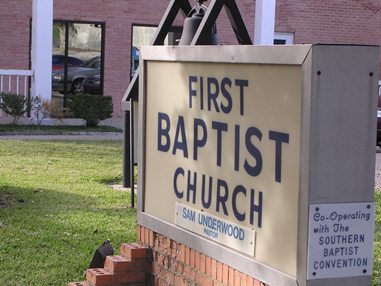
I saw Southern Baptist pastor Sam Underwood’s column about his visit to Dachau. It was more than I could take.

Underwood sermonizes on the “sinfulness of silence in the presence of evil.” He talks about the “commitment to stand alongside the weak, the vulnerable, the despised.”

“If we don’t stand with these,” he says, “evil will surely win.”

How in the world does this man presume to have the moral credibility to say such things?

Underwood himself has quite the track record of “silence in the presence of evil.”

He is the current pastor of my old childhood church, the First Baptist Church of Farmers Branch, Texas.

It’s the church where, as a faith-filled adolescent girl, I was sexually abused, repeatedly and severely, by the youth and education minister, Tommy Gilmore.

It’s the church that tried to intimidate me into silence, both when I was a kid and when I was an adult.

It’s the church whose music minister, Jim Moore, knew about the abuse when I was a kid and told me it would be better if I didn’t speak of it. The prior pastor also knew as did at least some of the deacons.

It’s the church that stayed silent about Gilmore’s abuse of a kid and allowed him to move on to work in children’s ministry at other Baptist churches in Texas, Georgia and Florida.

It’s the church that threatened to sue me when, as an adult, I again tried to speak of it.

It’s the church that, despite knowing the truth that the abuse took place, put me through many months of hell when, as an adult, I tried to get them to take action for the protection of others.

And guess who was at the helm of the church’s bullying attempt to silence me when I reported this evil as an adult?

Pastor Sam Underwood.

This man may have walked through Dachau, but it’s obvious he didn’t grasp the substance of the lessons there.

I’ve been to Dachau too. And I’ve talked at length with my friend, Elana, whose father was smuggled out of Germany as an 8-year-old boy and whose other ancestors were mostly all annihilated in the Holocaust. Perhaps because of her family history, Elana is an eyes-wide-open sort of person, and she doesn’t tolerate fools.

Elana would see through Sam Underwood in a millisecond. His words wouldn’t impress her even one tiny bit.

Sam Underwood had a clear opportunity “to stand alongside the weak and vulnerable,” but he chose silence instead. Not only did he choose silence for himself, but he also chose to try to silence me.

As pastor at the helm of that church, Sam Underwood tried to bully me into a silent oblivion so that the evil of what happened there would remain forever shrouded.

As my friend Elana would say, “Stop listening to their words. They have shown you what their true values are, and they have shown you over and over. Believe THAT!”

She’s right, and in more ways than one. Underwood himself was reported for sexual abuse of an adult congregant. There’s no dispute that it happened. The church acknowledged it with a letter from the deacon chair. They simply chose to minimize Underwood’s deeds as “sexual misconduct” rather than calling it “abuse.”

Given Underwood’s own history of bad deeds, it’s easy to see why he couldn’t bring himself to break silence about another minister’s sexual abuse of a kid.

Despite his deeds, the church kept Underwood as its pastor, just as it kept music minister Jim Moore, despite Moore’s longstanding silence about another minister’s sexual abuse of a kid.

That’s how it is in Baptistland. Evil deeds go without consequence.

Though Underwood might like to imagine himself as a person who would “stand alongside the weak and vulnerable,” he’s already demonstrated that he’s not. Even if evil tapped him on the shoulder and said “here I am,” Sam Underwood would still choose silence. He already has.

When I tried as an adult to report the minister’s molestation of me as a kid, the initial thing I asked of the church was that it place a small millstone sculpture on the grounds with a plaque saying that it was dedicated in prayer for victims of clergy sex abuse. I thought it was such a positive request. I thought it would be a way to focus attention on the problem and to remind people of the need for vigilance against clergy abuse.

But with Sam Underwood at the helm, First Baptist Church of Farmers Branch made very clear that they would never agree to such a “negative” thing. They didn’t want any reminder of the fact that something so ugly had happened in their church.

Sam Underwood wanted to avoid any memory of the evil that was done and covered-up at the First Baptist Church of Farmers Branch.

Nowadays, I click onto the church’s website no more than about twice per year. It’s a good thing, because look at what I encounter when I go there. It makes me angry.

Sam Underwood is a fool, and he doesn’t understand diddly-squat about Dachau.

When churches keep pastors like Sam Underwood at the helm, “evil will surely win.”
_________________________

Related posts:
My childhood church
Menorahs' lights bring thoughts on denial and evil