A few days ago, Southern Baptist minister Bernie Johnson wrote to ask that I delete all information about him from the StopBaptistPredators site. I’ve posted his email, in its entirety, below.
Bernie Johnson’s email provides a classic example of how some Baptist ministers twist forgiveness theology into a tool for hiding ugly deeds.
And make no mistake about it -- Bernie Johnson’s deeds were quite ugly. He was captured on videotape, and so there wasn’t much room for dispute. In a series of articles, The Examiner reported on Johnson’s deeds, and I gave a condensed version in this posting: “Convicted minister continues.” Click on it only if your stomach feels strong.
The question isn’t about forgiveness. It’s about whether those deeds should disqualify Bernie Johnson from continuing in a position of high trust as a Baptist minister.
It’s also about whether he should be allowed the possibility of moving on to still more churches without people finding out about his deeds so that they might decide for themselves whether this person should be their minister.
Bernie Johnson was already given one chance to have his deeds kept quiet. As reported in The Examiner, the leadership of Johnson’s prior church allowed him to quietly resign and even agreed to pay for his counseling on the condition that he not seek employment in ministry until his "restoration" was complete.
Johnson resigned, but then he got a similar ministry job just 10 miles down the road at the First Baptist Church of Winnie, Texas.
In other words, Bernie decided to do what Bernie wanted and to heck with the condition set by his prior church.
That’s when the woman decided to go to the police. Thank God she did. Now we have a public record along with a newspaper’s reporting on the case.
No. I will not delete the information from the website.
Nor will I give any heed to self-serving sermons on forgiveness that are made by Baptist ministers such as Bernie Johnson.
Here is his email. (Incidentally, I can’t figure out how he comes up with “4 years” since my prior blog posting was in 2008.)
"Dear Christa
For nearly 7 years my family and I have been making attempts to put my mistakes into the past and moving forward in uprightness. For the past 4 years or more your blog as kept the pain ever so fresh. Regardless of any testimony – two people know the truth of all my past events; me and God.
My wife and I, along with our son have worked intimately together to create the wholesome and honorable home God expects us to have. She has forgiven me, my son has forgiven me, my family has, and so has my church family. The only forgiveness I have not received is from you, someone who had absolutely no part in my life or its events. You do not “know” any of the truth of my life or its events. Why do you punish the forgiven? By what authority do you boast of your judgment toward others in matters that are not yours.
I have studied the Bible for the better part of 35 years, I have yet to find anytime where Jesus continued to pass any judgment on someone after they had been forgiven. Not a single instance. Once they confessed, turned from their wicked ways, and followed the course of Christ by picking up their cross and following Him daily – the angels rejoiced, and the Father reestablished the child.
I can’t make you do anything. I can only ask that you delete all the material on me so that my family and I can move on without further pain to anyone. When will enough be enough? 7 years, 14 years, 50 years? I am most grateful to the Lord God Almighty that His grace is ever present, His mercy is rich and new every morning, and that He does have a place for me in ministry now and in heaven later.
Please consider this a most sincere request of mine to you.
Your Friend in Jesus,
Bernie Johnson"
_____________________________
Update 9/23/10: Bernie Johnson has emailed me twice more, on 9/21 and 9/22. Basically, he sermonizes me on GRACE and MERCY (in all caps), tells me "you ought to read the Bible," and rails against me to "see more clearly your sinfulness" . . . as if he had any moral authority on any of this, right? But here's the part that really got me. He denigrates and bad-mouths his victim -- i.e., the woman who reported him to the police -- and I have no intention of repeating what he said. He expresses contempt for his victim. And his words make plain that this is a man who feels no genuine remorse whatsoever.
Another email from Bernie Johnson on 11/9/10: He just doesn't seem to get the message that I'm not impressed with his self-serving sermonizing. In this most recent email, he seems to be claiming that he has turned from "wicked ways," and that this should be "celebrated" rather than having his past posted on a blog. But here's what I think: 1) Why should I believe Bernie has "turned" (and indeed why should anyone believe him?) when, less than two months ago, he was still bad-mouthing his victim? 2) Even if it's true that Bernie has turned from "wicked ways," good for him, but I still don't think he has any entitlement to hold a position of high trust as a minister.
Sunday, September 12, 2010


Wednesday, September 8, 2010
Pastor's deeds teach silence in the presence of evil
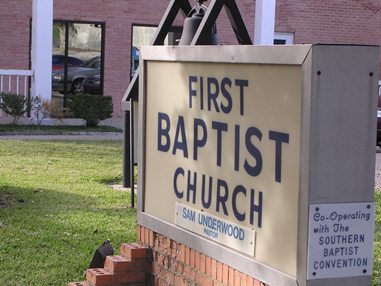 Today, I feel angry.
I know the feeling will soon pass, but for today, I feel angry.
I saw Southern Baptist pastor Sam Underwood’s column about his visit to Dachau. It was more than I could take.
Underwood sermonizes on the “sinfulness of silence in the presence of evil.” He talks about the “commitment to stand alongside the weak, the vulnerable, the despised.”
“If we don’t stand with these,” he says, “evil will surely win.”
How in the world does this man presume to have the moral credibility to say such things?
Underwood himself has quite the track record of “silence in the presence of evil.”
He is the current pastor of my old childhood church, the First Baptist Church of Farmers Branch, Texas.
It’s the church where, as a faith-filled adolescent girl, I was sexually abused, repeatedly and severely, by the youth and education minister, Tommy Gilmore.
It’s the church that tried to intimidate me into silence, both when I was a kid and when I was an adult.
It’s the church whose music minister, Jim Moore, knew about the abuse when I was a kid and told me it would be better if I didn’t speak of it. The prior pastor also knew as did at least some of the deacons.
It’s the church that stayed silent about Gilmore’s abuse of a kid and allowed him to move on to work in children’s ministry at other Baptist churches in Texas, Georgia and Florida.
It’s the church that threatened to sue me when, as an adult, I again tried to speak of it.
It’s the church that, despite knowing the truth that the abuse took place, put me through many months of hell when, as an adult, I tried to get them to take action for the protection of others.
And guess who was at the helm of the church’s bullying attempt to silence me when I reported this evil as an adult?
Pastor Sam Underwood.
This man may have walked through Dachau, but it’s obvious he didn’t grasp the substance of the lessons there.
I’ve been to Dachau too. And I’ve talked at length with my friend, Elana, whose father was smuggled out of Germany as an 8-year-old boy and whose other ancestors were mostly all annihilated in the Holocaust. Perhaps because of her family history, Elana is an eyes-wide-open sort of person, and she doesn’t tolerate fools.
Elana would see through Sam Underwood in a millisecond. His words wouldn’t impress her even one tiny bit.
Sam Underwood had a clear opportunity “to stand alongside the weak and vulnerable,” but he chose silence instead. Not only did he choose silence for himself, but he also chose to try to silence me.
As pastor at the helm of that church, Sam Underwood tried to bully me into a silent oblivion so that the evil of what happened there would remain forever shrouded.
As my friend Elana would say, “Stop listening to their words. They have shown you what their true values are, and they have shown you over and over. Believe THAT!”
She’s right, and in more ways than one. Underwood himself was reported for sexual abuse of an adult congregant. There’s no dispute that it happened. The church acknowledged it with a letter from the deacon chair. They simply chose to minimize Underwood’s deeds as “sexual misconduct” rather than calling it “abuse.”
Given Underwood’s own history of bad deeds, it’s easy to see why he couldn’t bring himself to break silence about another minister’s sexual abuse of a kid.
Despite his deeds, the church kept Underwood as its pastor, just as it kept music minister Jim Moore, despite Moore’s longstanding silence about another minister’s sexual abuse of a kid.
That’s how it is in Baptistland. Evil deeds go without consequence.
Though Underwood might like to imagine himself as a person who would “stand alongside the weak and vulnerable,” he’s already demonstrated that he’s not. Even if evil tapped him on the shoulder and said “here I am,” Sam Underwood would still choose silence. He already has.
When I tried as an adult to report the minister’s molestation of me as a kid, the initial thing I asked of the church was that it place a small millstone sculpture on the grounds with a plaque saying that it was dedicated in prayer for victims of clergy sex abuse. I thought it was such a positive request. I thought it would be a way to focus attention on the problem and to remind people of the need for vigilance against clergy abuse.
But with Sam Underwood at the helm, First Baptist Church of Farmers Branch made very clear that they would never agree to such a “negative” thing. They didn’t want any reminder of the fact that something so ugly had happened in their church.
Sam Underwood wanted to avoid any memory of the evil that was done and covered-up at the First Baptist Church of Farmers Branch.
Nowadays, I click onto the church’s website no more than about twice per year. It’s a good thing, because look at what I encounter when I go there. It makes me angry.
Sam Underwood is a fool, and he doesn’t understand diddly-squat about Dachau.
When churches keep pastors like Sam Underwood at the helm, “evil will surely win.”
_________________________
Related posts:
My childhood church
Menorahs' lights bring thoughts on denial and evil
Saturday, September 4, 2010
GRACE report vindicates missionary kids

According to a report made public last week, dozens of kids were sexually and physically abused at a boarding school in Senegal that was run by New Tribes Mission (NTM), an evangelical missionary-sending organization. The report not only documented the abuse, but also the cover-ups. NTM officials “created a mindset that ignored clear evidence of abuse, protected the perpetrators, and… shamed and even shunned the victims and their families.”
The GRACE report found “credible evidence” of countless acts of abuse that occurred beginning at least as early as the mid-1980s. The report identifies by name 12 individuals, who stand accused.
The impact of the abuse is a “catalogue of heartbreak and pain” that includes “denial, memory loss, depression, guilt, feelings of powerlessness, panic attacks, anger, fear, distrust of adults, suicidal thoughts and actions, self harming, eating disorders, substance abuse, sexual experimentation, sexual confusion, sexual repression, running away, turning to the occult, criminal behavior, imprisonment, and death.”
Yet, even as the missionary kids made repeated disclosures of abuse, and even as the evidence grew, NTM officials “repeatedly failed to report abuse to the authorities, to inform parents of the allegations, or to competently investigate the allegations. Rather, NTM officials “acted to protect the perpetrators and the institution at the expense of children.”
In 2009, NTM finally did something right. The Child Protection Committee of NTM recommended “a full and complete independent review of the actions of the New Tribes Mission” concerning the school in Senegal. Ultimately, the NTM Executive Board commissioned GRACE as the independent entity to conduct such an investigation. GRACE stands for Godly Response to Abuse in the Christian Environment. The GRACE team consisted of two former child sex-crime prosecutors (including Boz Tchividjian, the grandson of Billy Graham), one clinical psychologist, a professional counselor, and one teaching elder.
Of course, even NTM’s step of commissioning an investigation is a step that would never have happened without the extraordinary perseverance of some of the missionary kids who are now adults. For over a decade, and in the face of enormous resistance, they worked relentlessly to seek acknowledgement of the terrible wrongs and to prod NTM into action for the protection of others. Finally, they have been vindicated. I applaud them.
I also applaud GRACE, whose report is unflinching.
I yearn for the day when many hundreds of Baptist clergy abuse survivors may benefit from a similar process -- when their allegations will be looked into with respect and care by people who have the experience, training and objectivity to competently do so.
To have the faith community hear their stories with compassion and concern is something that almost all clergy abuse survivors long for. Tragically, it is something that most Baptist clergy abuse survivors never get . . . and that they ultimately lose all hope of getting.
If you read the 68-page GRACE report, many of you will see many familiar patterns from your own experiences in Baptistland. Let me highlight just a few of those patterns, together with the lessons of the GRACE report.
None of the NTM staff and officials who are named in the report have ever been criminally prosecuted. However, this did not in any way deter GRACE. Rather than looking to the standards of the criminal law, GRACE looked to whether there was “credible evidence” to support the allegations. This “degree of proof” was considered enough to draw conclusions that would serve the proper priority of protecting children. And as it turned out, much of the evidence was “compelling” and “unequivocal.”
GRACE was very critical of NTM officials who made excuses for their inaction by saying such things as “there was nothing definite” . . . “no details” . . . “only allegations” . . . and “only bits of inappropriate behavior.” GRACE pointed out that these excuses made “clear” that NTM leadership was trying to do little more than get themselves off “the hot seat.”
The victims’ favorable response to the GRACE investigation demonstrates why it is essential that those who review abuse allegations be independent of the place where the abuse occurred. GRACE sent initial questionnaires to 108 former students at the NTM boarding school. Fifty-six responded, yielding a return rate of 52 percent. This contrasted with the 3 percent return rate for an earlier survey that was done by NTM officials. As GRACE pointed out, the NTM officials lacked the training and experience to appropriately question people about abuse, and they took a hostile posture toward the victims. Indeed, given that many of the missionary kids had tried to tell about abuse when they were younger -- only to be rejected, silenced and further shamed -- it’s no wonder they were reluctant to again speak of their abuse with people who had failed them so miserably before.
The conduct of New Tribes officials effectively emphasized “the saving of souls at the expense of children,” says GRACE, and that is what made the abuse and nonresponsiveness predictable.
So often we have seen a similar misplaced emphasis from Baptist officials, and the consequences have been devastating.
We see it in local church officials who seek to protect the “witness of the church” by quietly letting accused ministers move on. It is children at the minister’s next church who pay the price.
We see it in denominational officials who claim that Cooperative Program dollars can be used only for missions and pursuit of the Great Commission. They refuse any resources for implementing independent assessments of clergy abuse allegations or for keeping records on credibly accused clergy. As a result, predatory preachers are able to easily church-hop, and it is children who pay the price.
When so many religious leaders use “saving souls” as a rationalization for doing nothing about ministers who molest kids, it makes abuse and cover-ups predictable. As the GRACE report explains: "In the abstract... the church is always opposed to the physical, sexual and emotional violation of a child’s body and mind. When faced with the reality of abuse, however, the church is slow to side with the victim and quick to protect the perpetrator."
I hope and pray that Southern Baptist leaders will read the GRACE report and learn from it. May they soon find within themselves the moral fiber to fully confront the reality of clergy abuse in their own ranks. The safety of children depends on it.
_______________________
Update: "Missionary group admits Senegal abuse," Journal Sentinel (Milwaukee), 9/17/10 ("A Christian missionary group... said it will purge its ranks, strengthen its personnel policies and set aside $1 million to aid victims, in response to a new report that dozens of missionaries' children endured physical and sexual abuse at its boarding school in Senegal.")
Wednesday, September 1, 2010
"No contest" doesn't mean no evidence
Jim is the director of a poverty relief Christian ministry in Tennessee. One of his staff members is an ordained Baptist minister who, in 2006, was charged by Georgia authorities on 16 counts of child pornography, 2 counts of child molestation, and 2 counts of enticing a child for indecent purposes. News about the minister was reported in a newspaper article, which is posted on the StopBaptistPredators website.
A few days ago, Jim wrote to me. He wants me to delete the article off the website.
Jim’s email is too long to post, but I’ll give you the highlights along with my reaction.
Jim starts off by telling me that, because their ministry is connected to a Baptist college, they have “very good guidelines in trying to screen our employees.” In fact, he says, Jim Gunther who is attorney for both the college and the Southern Baptist Convention, “helped us a lot with our procedures and policies.”
I suppose he thought that dropping Jim Gunther’s name might make a positive impression on me. He was sure wrong about that. After all, back when I was trying desperately to locate my own childhood molester, Jim Gunther is the attorney who signed off on a letter saying that the Southern Baptist Convention had no record the man was still in ministry in any church. Yet, he was actually still working in children’s ministry at a Florida Baptist church. And he had previously worked in the church of former Florida Baptist Convention president Dwayne Mercer and in the church of former SBC president Charles Stanley. Given his high-level connections, it was impossible for me to believe that Baptist officials didn’t know where he was. The fact that they would disclaim any record of him seemed like little more than a ruse.
So I’m not impressed by that sort of name-dropping.
And I sure can’t figure out why Jim thinks I would be impressed by the fact that his poverty relief ministry is connected to a Baptist college. When I think about Baptist colleges, I think about how Baylor University allowed “murdering minister” Matt Baker into its program at Truett Seminary despite the fact of multiple sexual abuse reports and despite the fact that, even at Baylor itself, Baker had been reported for sexual assault when he was a ministerial student in its undergraduate school.
So . . . connection to a Baptist college doesn’t give me any good reason to think there will be good guidelines in place.
But Jim says he has “known” the minister for years and that he is “thoroughly convinced” there was no abuse.
It’s a tired refrain, isn’t it? There are always those who think they “know” the guy.
If I had a dollar for every time someone said they “know” the guy, I’d have a pile of money big enough to buy a new bicycle. I’d get one of those spiffy cruiser kinds -- they’re pretty pricey.
Suffice it to say that I’m not impressed by Jim’s insistence that he “knows” the guy.
Besides, Jim himself points out that the minister pled “no contest” to the charges. “There was never any evidence presented against him in court,” says Jim.
These are troubling statements. Jim seems to think the minister’s “no contest” plea means he was innocent. But it doesn’t.
Generally, a defendant’s “no contest” plea is considered as constituting an acknowledgement that there is enough evidence on which a conviction could be had. Often, a defendant will plead “no contest” for the very purpose of avoiding presentation of the evidence in open court and also to avoid the risk of greater punishment if the case goes to a full trial.
So, Jim's statement that there was no evidence "presented...in court" is meaningless. Once a “no contest” plea is made, the evidence doesn’t get presented in court. That’s how it works. But that doesn’t mean there wasn’t any evidence. To the contrary, it means there was evidence.
In other major faith groups, evidence related to clergy child molestation may be evaluated by a denominational review board, regardless of whether the man is criminally convicted in a court. If abuse allegations are determined to be credible, the minister may be “defrocked” or have his ordination revoked.
But not so with Southern Baptists. There is no such thing as a denominational review board for the assessment of clergy sex abuse allegations.
So kids in Baptist churches don’t get the same safeguards against predatory clergy as what kids in other faith groups now get.
This Baptist minister, who is on staff at Jim’s poverty relief organization, is known to have worked in Texas, Georgia and Tennessee. (He lasted only a few months in Texas, where he also worked as director of a Boys’ and Girls’ Club.)
If this minister wanted, he could move to Florida tomorrow and could probably get a job in a Baptist church. There isn’t any denominational office that’s going to revoke his ordination. There isn’t any denominational office that will say “Whoa … this man can’t be a Baptist minister.” There isn’t any denominational office that will warn the next church that hires him. There isn’t even any denominational office that’s keeping systematic records on Baptist ministers like this.
A published news article might be one of the few possibilities by which people could find out about this minister’s prior history.
So, no, I won’t delete the article from the website.
I don’t have any desire to embarrass this poverty relief organization, and I don’t know what job duties the minister has there. Perhaps he’s doing roof repairs. But if his duties allow any sort of unsupervised access to kids, and if he is still able to hold himself out as an ordained Baptist minister (which he almost certainly is), then that’s wrong -- dangerously wrong.
Jim concludes by telling me what an “awesome ministry” their organization provides and by complaining about what a “thorn in the side” it is when people find the article about this staff-member on the internet. Nevertheless, Jim says that his “foremost” concern is for “his own ministry” -- i.e., for the ministry of the staff-member who pled “no contest” on child porn and child molestation charges.
This is where Jim got it all wrong from the get-go. His priorities aren't straight.
Jim’s “foremost” concern should be for the protection of kids, not for the minister.
_________________________
Much of the above goes ditto for the guy who, last week, asked me to “help out the church -- God’s church” by deleting articles on convicted Baptist minister Kevin Ogle, also from Georgia.
9/4/10 on Baptist Planet: 'Stop Baptist Predators' isn't in the track-covering business
Update 9/8/10: Jim has written to say that he was mistaken and that it was actually a "no bill" rather than a "no contest." If Jim is correct this time around, then a "no bill" would usually mean that a grand jury decided there was insufficient evidence to warrant the pursuit of a criminal prosecution under the stringent standards and burdens of the criminal law.
Tuesday, August 24, 2010
Baptists must face fear and prioritize risks
Southern Baptist leaders refuse to take action on reports of clergy sex abuse because they claim it’s up to the local church. They say that all those 43,000 local churches should just tell other churches about anything troubling in a minister’s past conduct.
But that’s not what happens in the real world, and we all know it. Southern Baptist leaders know it too.
For starters, churches are afraid.
A Texas Monthly journalist pondered this reality when he considered the question of why Southern Baptist pastor Matt Baker was able to keep church-hopping despite the many abuse and assault accusations against him. He offered this explanation:
"To avoid defamation lawsuits, leaders of a church have an incentive to keep their mouths shut when it comes to questionable behavior among clergy, which is perhaps why First Baptist officials said nothing about the allegations when other churches later called, interested in hiring Matt.”
Churches are afraid of being sued by the very ministers who cause trouble. It’s easier to just let a minister move on. It’s easier to “pass the trash.” It’s easier for church leaders to simply keep their mouths shut when other churches call for a reference.
It’s not right. But it’s reality.
The average Baptist church has less than 100 people in the pews on Sunday morning. It needs to keep money coming into the offering plate so it can pay the salaries, keep the lights on, and maybe make the mortgage payment. It doesn’t have extra cash to spend on legal fees. So when trouble with a minister rears its ugly head, it’s easier to quietly let the minister go than to worry about the lawsuit he might bring if you say something to his next employer.
“Besides,” they tell themselves, “we don’t actually KNOW anything for sure, do we?”
The excuses they come up with are cowardly. But I understand their fear.
It’s similar to the fear that many Baptist survivors deal with because the denomination doesn’t provide any safe place for reporting clergy abuse. So what happens? The ministers may accuse us of “slander.” And the churches usually stand behind the ministers . . . even when we have significant substantiation. And no one in the denomination helps us. We’re out on a limb all alone.
So I understand what that fear of a lawsuit feels like. In my own case, even though the church’s music minister knew about the other minister’s molestation of me as a kid, the church still threatened to sue me when I reported it. And they did it with help from the attorney for the largest statewide Baptist organization in the country, the Baptist General Convention of Texas.
I was intimidated. I felt afraid. I nearly went right back to keeping my mouth shut. So yeah… I understand that fear.
Accused ministers often use fear to silence church leaders. And church leaders use fear to silence victims.
It stinks. Fear usually does.
But what stinks even worse is that Southern Baptist leaders refuse to help churches deal with that fear in a responsible manner. They refuse to provide churches with the resource of an office for the objective assessment of clergy abuse reports, and they refuse to keep any denominational records on clergy who have been credibly accused.
Instead, Southern Baptist leaders wash their hands of it and say “not our problem.”
They wash their hands of it and tell all the 43,000 local churches “it’s your problem.”
The reason Southern Baptist leaders wash their hands of it is because they too are afraid. They’re afraid of the risk of liability.
That’s what “Louis,” a frequent commenter on Baptist blogs, says, and I’ve seen others say it as well. Louis is an attorney, and some say he’s on an SBC-related board. (I’m only about 90 percent sure of who Louis is and so I’ll leave off his identity.) But this is likely a man who advises high-level Southern Baptist officials, and this is what he says:
“If the SBC endeavors to take this on and begins investigating, keeping records, dossiers on people, whatever. It opens itself up to liability if it fails to perform that function correctly.”
Louis is right. There is always risk connected to responsibility. But that’s all the more reason why the Southern Baptist Convention should take on that risk. It has more resources to better deal with that risk than the average church does.
In essence, Southern Baptist leaders are telling local churches that they should do the very thing that Southern Baptist leaders themselves are afraid to do. They’re telling local churches that they should face their fear and “make that call” to a sister church. Yet, Southern Baptist leaders won’t even hear complaints about ministers, and they sure won’t face their fear and actually tell churches about credibly-accused ministers.
They want to lead by talk but not by example.
Southern Baptist leaders want to avoid any potential liability risk because they want to protect their mighty coffers. But local churches also care about their coffers even though the dollar amounts are smaller. Just because a local church has less money in the bank doesn’t mean it worries about that money any less.
Change carries risk. But the status quo also carries risk. What Southern Baptists need to consider is how they prioritize the risks. As things stand, Southern Baptists are prioritizing protection for the institution far ahead of protection for kids.
It’s apparent that attorneys such as Louis have been giving Baptist officials the same advice for a lot of years: If the SBC does nothing, it won’t open itself up to the risk of liability.
I first saw Louis’ analysis a couple years ago in comments on the Burleson blog; I saw it a few days ago on the SBC Voices blog, and I’ve seen it repeatedly on other blogs.
It’s an analysis that reflects the nature of how attorneys think. They are trained to be risk-averse on behalf of their clients.
But here’s the thing: Louis is being risk-averse on behalf of the institution of the Southern Baptist Convention. He’s not being risk-averse on behalf of the local churches, and nor is he being risk-averse on behalf of the kids who are within those churches.
Louis is looking out for the institution.
So, is that what the SBC’s do-nothingness comes down to? Institutional self-protection? Minimizing risk to the organization’s coffers? (Of course, the SBC could possibly insure against that risk, but that’s another topic….)
If indeed the fear of liability risk is the reason why Southern Baptist leaders won’t provide churches with information about credibly-accused clergy predators, then they should let people in the pews know this. Debate it openly and honestly. Quit telling people that it’s because of biblical principles. Quit telling people that Baptist do-nothingness is based on Baptist polity.
Mistakes happen in almost all human endeavors . . . and yes, mistakes open institutions to the risk of potential liability. But other major faith groups have taken on that risk of liability in order to take action that lessens the risk to kids.
Aren’t Southern Baptist kids just as worthy of protection as Catholic, Episcopal, Presbyterian and Lutheran kids?
Is it any wonder that many question whether the Baptist faith holds any true meaning?
One thing for sure: The message of Jesus wasn’t about institutional self-protection.
______________________
Related article: "SBC president questions motives of SNAP, says sex abuse everywhere," EthicsDaily, 5/27/2007
Saturday, August 21, 2010
Messy messy hornets' nest
The SBC Voices blog is trafficked largely by Southern Baptist pastors, ministers and denominational leaders. Recently, a couple postings got into the clergy sex abuse issue, and as usual, when these guys get going on this subject, some of the comments can be pretty depressing to read. But “Bill” provided a comment worth sharing here. He said this:
“I worked for a church that quickly and quietly got rid of a youth pastor mired in accusations of child abuse and he went to work for at least two other churches before he finally wound up in our court systems and is currently doing a lot of time. The pastor of my old church never personally recovered from this ordeal and personally feels responsible for the children who were proven right so many years later. He also feels that the children of these other churches are his responsibility too. However, he says that you don’t want to be the person to destroy a fellow minister, but he feels he destroyed the lives of at least a dozen boys/young men in trying to protect this one pastor. . . .
I do think something should be done but I think that there are so many areas to act on in order to address this issue head on, that no one will be courageous enough to stand the intense hatred pointed in their direction should they even suggest something to the SBC . . . . It’s a messy, messy hornets’ nest that everyone’s too afraid to stir up and the predators know it.”
Bill is right: “It’s a messy, messy hornets’ nest” and everyone is afraid. But it’s time the Southern Baptist Convention started providing leadership for responsibly dealing with that fear. Any fool can see that all their pretty pamphlets are little more than a pretense of dealing with it . . . and as Bill says . . . “the predators know it.”
Bill’s story is nothing unusual. Over a long period of time, countless Baptist ministers have been allowed to move on to other churches despite allegations of abuse. And as a result, many more kids have been dreadfully wounded within the faith community.
Oh sure . . . the ministers aren’t actually “assigned” to a new church. They’re simply allowed to move on. But whether “assigned” or “allowed,” the molested kids are no less wounded.
I don’t know the specifics of Bill’s particular story, but I know the usual and frequent pattern of many similar stories.
Imagine that a kid named “Joe” was one of that youth minister’s earlier victims. The pastor of the church suspected something, but decided it was better to let sleeping dogs lie and to let the youth minister go elsewhere.
Joe spent the next decade trying to figure out how to live with the trauma of having been molested and sodomized by a minister who wielded words of God as a weapon. He tried desperately to wall off any thought of what was, in any event, unthinkable.
Finally, Joe couldn’t keep it all inside anymore. As he began to deal with the reality of what the minister had done, he worried endlessly about others. But by then, it was too late for criminal prosecution (as most cases are). So a decade later, Joe went back to the church of his childhood to try to tell people and to try to get some help for protecting others.
Given that the pastor couldn’t muster the courage to take responsible action when the molesting youth minister was right there in his own church, do you imagine that he’s going to take action to help Joe now, when Joe hasn’t set foot in the church in over 10 years and when the youth minister is long gone?
No. That’s not what typically happens. The pastor shrugs his shoulders and says something like this, “Not my problem. That minister isn’t even at our church anymore. I don’t know where he is.”
So, on his own, Joe tries to find the minister who molested him. Maybe he’ll be able to, and maybe he won’t. A lot of Southern Baptist ministers aren’t listed on the SBC’s registry of ministers. (For example, here’s a church in which not one man in their 17-member ministerial staff was listed on the SBC’s registry of ministers.)
But imagine that Joe gets lucky and finds the man. When Joe sees that he’s still a Southern Baptist minister working in a position of trust with kids, Joe feels all the more desperate.
Joe contacts the chairman of the deacons at the man’s current church. But the deacon says, “Not my problem. What you’re talking about involves some other church. We haven’t had any complaints and our ministers are men of God.”
So, Joe turns to people at the local association, at the state convention, and finally at national Southern Baptist headquarters.
Every step of the way, the response he gets is some version of “Not my problem. Local church autonomy.”
Joe gives up, and for many years more, the man continues working as a Southern Baptist minister whom kids and their parents trust almost completely.
Finally, one kid’s parents suspect something and report it to the police in time for prosecution. The man is criminally convicted and, because he’s sitting in prison, he’s no longer working as a Baptist minister.
But between the time when Joe first started trying to talk to people and the time when the minister was criminally convicted, at least a dozen more boys were molested and sodomized by that same Baptist minister who wielded words of God as a weapon.
Those are the kids whose nightmares might have been spared if Baptists would do what other major faith groups have done by creating a safe place where victims could report clergy abuse -- a place where victims’ reports would be responsibly assessed and where records of credible allegations would be kept.
Furthermore, it sure would have helped to ease Joe's mind.
But as Bill says, “everyone’s too afraid.”
“Everyone’s too afraid” to even hear people like Joe.
Wednesday, August 18, 2010
"Killing the Buddha" reviews "This Little Light"
“If religion matters at all, it matters enough to be taken to task.”
That quote is from the manifesto of Killing the Buddha. It’s “a religion magazine for people made anxious by churches.”
I’m honored that Killing the Buddha chose to review my book, This Little Light. The review, written by Josh Garrett-Davis, is titled "All Part of His Plan." Here are some excerpts, and you can read the entirety of his review at Killing the Buddha.
“Christa Brown’s book, This Little Light: Beyond a Baptist Predator Preacher and His Gang, is a powerful document . . . . Brown recounts her own abuse at age sixteen by the youth and education minister at the First Baptist Church of Farmers Branch, Texas. Then, in Baptist style, she moves from testimony to evangelism, detailing her struggles to convince the church establishment to try to prevent future abuse by other ministers. The book is well written, clear-eyed, and honest.”
“There is nothing to suggest that sexual abuse is more or less common in the Baptist Church than in the Catholic Church or Hasidic Jewish communities, or even the Boy Scouts. But particularities of Baptist doctrine and culture have allowed the problem to remain invisible longer. . . . Like states’ rights, congregational autonomy turns out to be conveniently useful for protecting the powerful.”
“The other striking thing about the Baptist case . . . is the rather blatant misogyny she encounters among the clergy — not just sexism but actual contempt for women. For Brown, this began with her abuser, who, presumably feeling ambivalent about cheating on his wife by raping a sixteen-year-old, tells Christa she is a temptress, a “serpent,” and “Satan’s ally.” Before he leaves for another church, he makes Christa apologize to his eight-months-pregnant wife for leading him astray. The assumption is that a man is pure and tempted by evil, whereas a woman, once she reaches any level of sexual maturity, is at heart an evil seductress who must check herself.”
“… Perhaps it is the church’s nearly all-male clergy that steels the resistance to act against child abuse. Women are to submit graciously, are not to speak in church. The men seem to have little concern for protecting the weak.”
Monday, August 16, 2010
Iowa church illustrates low standards of Baptistland
A Southern Baptist minister in Davenport, Iowa, was arrested last Saturday and charged with the sexual abuse of two kids.
But this wasn’t Terry VanHoutan’s first run-in with the law. He pled guilty to two counts of indecent exposure back in 2001.
So why did the First Baptist Church of Bettendorf make him a minister?
As reported by KWQC-TV, Terry VanHoutan had been at First Baptist of Bettendorf for “several years,” and it was the First Baptist Church of Bettendorf that “licensed” VanHoutan as a minister.
VanHoutan’s prior convictions were in 2001. Even if you push “several years” to mean five or six, this would still mean that the church ordained VanHoutan as a minister after his prior 2001 convictions.
I guess the good people at First Baptist of Bettendorf just didn’t care . . . or else they just didn’t bother.
Either way, their recklessness put at risk not only the kids of their own church, but it also put at risk Baptist church kids all over the country.
That’s the thing about Baptistland. Once a minister gets ordained by one church, he can then migrate to other churches. If VanHoutan hadn’t been arrested . . . again . . . he could have easily moved on to some other church in Baptistland.
Any Baptist church can ordain virtually anyone as a minister. But ministers don’t have to stay with the church that ordained them.
As a practical matter, this means that the church with the lowest standard can set the standard in Baptistland.
And no matter how low a church’s standard for qualifying a minister, the ordained man can then carry the mantle of ministerial trust into other churches.
A single church ordains the man, but he is ordained for much more than a single church.
Baptist churches ordain ministers, not only for their own church, but for all churches. Effectively, once a man is ordained by one church, he then has a “license” to roam.
This means that the laxity of a single church can unleash a preacher-predator within the broader denominational body.
Yet, the denomination exercises no oversight.
For Baptist ministers, there isn’t even any entrance hurdle into the profession. No initial check. No exam. No nothing. There isn’t even any requirement that a Baptist minister be someone who has attended seminary.
Any man who can convince a handful of deacons that he’s been “called by God” can get himself ordained as a Baptist minister.
It’s the perfect set-up for a good con-man.
With no entry hurdle for ministers, with a porous network of churches to migrate through, and with no denominational oversight, the Southern Baptist Convention presents a near-perfect paradise for preacher-predators.
______________________
See also this article in the Quad-City Times: “Davenport man accused of sex abuse against minors.” It makes not one mention of the fact that the “man” is a minister, and so it’s another example of what I talked about in my August 10th posting -- low-profile press coverage that we see too often in Baptist clergy sex abuse cases.
Thursday, August 12, 2010
Baptist World Alliance needs common voice on clergy sex abuse
 A prominent British Baptist minister is being held in a Virginia jail on charges of child molestation. Robert Dando, the senior minister of Worcester Park Baptist Church in suburban London, is charged with four counts of aggravated sexual battery of a victim younger than 13.
Dando previously served as executive assistant to the president of the Baptist World Alliance, David Coffey. Thus, Dando was closely connected to the highest levels of Baptist worldwide leadership. (That's Dando in the photo.)
“The Baptist World Alliance … is the public face of Baptists worldwide.” So says Bruce Gourley, the executive director of the Baptist History and Heritage Society.
The Baptist World Alliance is comprised of all manner of Baptists from all over the world, and it claims to represent almost 40 million people of Baptist faith. Indeed, it includes almost all Baptist groups except the largest of them, the Southern Baptist Convention.
Just as most of the non-Muslim world tends to lump all Muslims together, so too most of the non-Baptist world tends to lump all Baptists together. The rest of the world is largely oblivious to the sorts of distinctions that Baptists make among themselves.
To most of the world, a “Baptist” is a “Baptist” is a “Baptist” is a “Baptist.”
It is the name “Baptist” that carries the brand of this global faith community, and not “Southern” or “Cooperative” or “Free Will” or any of the other numerous adjectives that get put in front of “Baptist.”
When ordinary people read of a “Baptist” minister charged on child sex abuse, they don’t usually give much thought to the particulars of precisely what kind of Baptist it is. In the eyes of the world, all Baptists wind up being tainted by the endless plague of Baptist clergy abuse and cover-up cases.
Therefore, all Baptists share a common interest in ridding their ranks of clergy predators, and all Baptists need to work cooperatively to effectively address the scourge of clergy sex abuse.
They should do it, not only to preserve the goodwill of the “Baptist” brand, but because it is the right thing to do. After all, at their recent conference in Honolulu, Baptist World Alliance leaders focused on the message of Luke 4 in which Jesus proclaimed part of his mission as “release” for the “oppressed.”
In Baptistland, who are more “oppressed” than those who have been molested, raped and sodomized by Baptist clergy? We are the pariahs -- the ones whom no one wants to see.
How do Baptists imagine that they will “release” those who have been “oppressed” within their own faith group if they refuse to even listen to them? Yet, in most Baptist faith groups, there doesn’t even exist a safe place to which Baptist abuse victims may report clergy sex abuse.
Unless a Baptist minister is criminally convicted and sitting in prison, he can usually stand in a Baptist pulpit. There is typically no one in Baptistland who will even bother to look into an abuse report.
When their own faith is used as a force for oppression, and when the most vulnerable among them are wounded by the most powerful, Baptists provide nowhere to turn. Baptists are blind to the oppression in their own Baptist yard.
If indeed the Baptist World Alliance is to carry “the Baptist torch” into the 21st century, then it must forge a common voice for fighting Baptist clergy sex abuse and for ministering to those who have been wounded by Baptist clergy.
The rest of the world is watching.
_______________________
Updates:
- "Church minister Robert Dando faces U.S. child sex charges," BBC News, 8/19/10
- "British Baptist Church minister arrested on child sex charges in the U.S.," The Daily Mail, 8/20/10 (Robert Dando also had access to children through his work at the Boys' Brigade in Britain and a children's charity in India.)
Tuesday, August 10, 2010
Man AND Minister
I gotta tell you. This is the sort of thing that drives me nuts. So I’m just gonna go ahead and rant a bit.
The headline in The Daily Home of Alabama said this: “Pell City man pleads guilty to sexual abuse.”
But here’s the thing . . . this “man” who pled guilty to sexual abuse wasn’t just any man in town. This “man” who pled guilty to sexual abuse was a Southern Baptist minister at the Eden Westside Baptist Church in Pell City. It’s a church that claims 1,702 in membership and has an average attendance of 750.
In Pell City, Alabama, that probably makes it a pretty prominent church.
And one of their ministers, Gregory Lee Bowman, just pled guilty to sexually abusing a 14-year-old kid.
And the newspaper reports it as “man pleads guilty.”
If that were a Catholic priest, do you think the headline would have been “man pleads guilty”?
I think it would have been “priest pleads guilty.”
So here in the South, why is it so often glossed over when the “man” is actually a Southern Baptist minister?
You tell me.
I’ve seen this sort of low-profile news coverage of Baptist clergy abuse cases over and over again. And frankly, it makes me angry.
At least The Daily Home mentioned in the body of the article that the “man” was a minister. I’ve seen news reports that didn’t mention it at all -- as though the “man” were just some ordinary guy off the street.
Yet, when the “man” who abuses a kid is a minister in a Baptist church, it is news that deserves to get the attention of people in the community.
It is news that deserves a headline with something more than “man.”
Friday, August 6, 2010
It's a "business decision"
In a series of comments on Debbie Kaufman’s blog, “Mary” provided a candid explanation for why Baptist leaders won’t take the sorts of steps that other major faith groups take toward addressing clergy sex abuse. Here is her answer for why the Southern Baptist Convention won’t provide a trained panel for objectively assessing clergy abuse reports and won’t keep a database on credibly-accused Baptist ministers.
“The SBC is just not going to take on the liability that a national database would expose it to … it’s the reality in the litigeous society we live in,” says Mary.
Okay. Got it. SBC leaders are afraid of being sued.
Mary continues: “A lawyer would say you couldn’t list ‘credibly accused’ because of the fear of slander/defamation suits.”
Okay. Got it. SBC leaders are specifically afraid of suits for slander and defamation.
“Can a person sue the SBC and get a lot of money for having their name put on a ‘credibly accused’ list? Uhhh yeah," she says. "If the SBC were to decide to investigate and compile databases of accused/convicted/confessed than they are not just ‘providing information’ but ‘assuming a duty’ (legal term) which opens them up to not a small amount of liability. The SBC does not have unlimited resources and so yes they have to make what seems like cold and a calculated ‘business’ decisions in the stewardship over those resources.”
Okay. Got it. The SBC is making a “business decision” to lessen their risk of liability.
So there you have it, folks. The reason the SBC won’t keep records on credibly accused clergy predators is because they’re afraid of being sued by their own credibly accused clergy predators.
Thank God that “Mary” at least had the decency to speak the truth about the fact that it’s a “business decision.” I’m so weary of the many Baptist leaders who promote the false propaganda that their do-nothingness is a religious decision.
Of course, I don’t agree for one second with “Mary’s” apparent view that this “business decision” is right. To the contrary, I think it’s an utterly immoral decision. And I definitely don’t buy the post-hoc rationalization that this “business decision” is about “stewardship.”
If Baptist leaders were genuinely concerned about “stewardship,” wouldn’t they also care about “stewardship” of the next generation?
But “Mary” (who probably isn’t really a “she” much less a “Mary”) has expressed the reality of what’s going on in Baptistland. For that, he deserves thanks.
The sooner Baptist leaders speak honestly about the real reasons for their do-nothingness, the sooner kids in Baptistland will have a better chance of being better protected.
But so long as Baptist leaders claim their do-nothingness is biblically-based, they cut off the possibility for genuine debate. Few in Baptistland will want to argue with “the Bible tells me so.”
“Mary” has spoken the truth: it’s a “business decision.” Baptist leaders are exploiting their own religious polity to use it as an excuse for what is, in reality, a “business decision” to shield the institution of the Southern Baptist Convention from the risk of liability.
But what about shielding kids against the risk of clergy predators?
That’s the thing about business decisions. They involve trade-offs. And Baptist leaders are effectively choosing to sacrifice the safety of kids on the altar of institutional self-protection.
It may be an astute “business decision” for the institution of the Southern Baptist Convention, but it is a morally unconscionable decision in light of the human beings who are affected.
A lot of churches make a similar trade-off. To avoid the risk of defamation lawsuits, church leaders often don’t say anything when other churches call for a reference on a prior minister who was let go in the face of ugly allegations. Church leaders cave into their fear and protect the institution of the church rather than doing what’s right and protecting kids.
It stinks. Fear usually does.
But what stinks even worse is the do-nothing “business decision” of Southern Baptist leaders.
Churches need help. And the Southern Baptist Convention has far greater resources for handling the risk of defamation lawsuits (and for possibly insuring against them) than do most local churches.
Yet, rather than helping churches by providing the resource of objective assessments on abuse allegations, and rather than protecting kids by providing a database of credibly-accused clergy, Southern Baptist leaders opt to protect the institution against the risk of being sued.
Rather than taking onto their own shoulders the risk of defamation lawsuits, they leave the risk of clergy sex abuse on the backs of innocent kids.
Monday, August 2, 2010
Bolivar Baptist Baloney
 Thanks to a reader for tipping me to this July 31st five-star review that was posted on the ChurchRater website. It’s about Bolivar Baptist in Sanger, Texas. Check it out.
____________________
Bolivar Baptist Church
West Hwy 455
Sanger
Texas
76266
Senior Pastor: Dickie Amyx
Denomination: Baptist
"Wonderful, fun, inspiring, love God, fellowship of friends, great music, great people"
"I drive 25 miles to go to this church because it is the most wonderful
place. The people are that best you could meet anywhere. You will be welcomed with open arms - literally. The preacher is very down to earth and absolutely inspired of God. You will laugh, maybe cry. The musicians are amazing. For such a small place, there is an amazing amount of talent. Come join us!"
____________________________
So . . . do you remember the true story behind Baptist pastor Dickie Amyx? If you do, then you’re probably already gagging.
And “absolutely inspired of God” are not the words that come to mind.
This is the preacher who defended against clergy molestation allegations by claiming: “I didn’t have sex with her when she was 16 or under.” This is the preacher who excused his abusive conduct by saying, “I told her many times I never meant to hurt her.”
This is the preacher who admitted to having sex with Debbie Vasquez 20 to 40 times, and who impregnated Debbie when she was 18. This is the preacher against whom Debbie Vasquez had to go to court for a paternity judgment to get him to finally provide support for the child he fathered . . . who by then was 8 years old.
This is the preacher who Debbie Vasquez says began abusing her when she was 14, raped her when she was 15, and continued to abuse her for long after. Personally, I believe Debbie. But here’s the thing . . . even if you believe the preacher, you’ve still got a man who, by his own word, acknowledges the sexual abuse of a church kid and rationalizes it by claiming “I didn’t have sex with her when she was 16 or under.”
Yet, despite his own admissions, pastor Dickie Amyx remains a Southern Baptist minister. (That's Amyx in the photo.)
Apparently there was no one in his congregation who was capable of hearing the seriousness of his admissions.
No one else in Baptistland has been willing to hear those admissions either. That’s the problem.
There is no one in denominational leadership who will speak up and say that this man should not be in a position of pastoral trust.
There is no one in denominational leadership who will take a stand and say that this man should not be allowed to carry the Baptist brand as a pastor.
There is no one in denominational leadership who will assess this man’s admissions and speak the truth of the fact that they constitute admissions of sexual abuse which render him unfit for being a pastor.
There is no one in the Southern Baptist Convention nor anyone at the Baptist General Convention of Texas who will do diddly-squat.
This is the sort of pastor whom Baptist leaders quietly tolerate with their denominational do-nothingness.
This is the sort of pastor whose continued presence in the pulpit sends the message that Baptists don’t really give a hoot about clergy sex abuse.
______________________________________
Prior related postings:
“Start with this one” and “Okay, so start with the admitted ones”
News sources on the story of Baptist pastor Dickie Amyx:
Denton Record-Chronicle
Nashville Scene
______________________________________
Update 8/3/2010: The ChurchRater website has removed the review on Bolivar Baptist. Hooray!
Subscribe to:
Posts (Atom)


 Posts